As bike riders, we understand the unique issues facing cyclists, especially when riding in busy urban areas. The personal injury attorneys at Rahman Law PC are knowledgeable about the special laws for bicyclists.
California Assembly Bill Number 122 was introduced in December of 2020 but has undergone some amendments in March and May of 2021, as is typical in the lifecycle of an Assembly Bill. Here’s what you need to know about Assembly Bill 122 to limit bicycle accidents from a bicycle accident lawyer’s perspective.
First, it’s important to know that more than a dozen bicycle advocacy organizations support the Bill across the state of California, including MCBC (Marin County Bicycle Coalition, an organization focused on bicycle safety which we support). Also, other states already have similar vehicle codes in place, including Washington, Oregon, Idaho, Colorado, Arkansas, and Delaware, which means AB 122 is not a new concept.
What does AB 122 Change?
If passed, California Assembly Bill Number 122 would change the vehicle code in California to allow bicyclists to treat Stop signs as they would a Yield sign. This increases bicycle rider safety and decreases bicycle accidents, which has been demonstrated in studies in Idaho (who was first to create the stop-as-yield law) and Delaware. In 2008, an investigation was conducted locally by the San Francisco Bay Area Metropolitan Transportation Commission, which has added to the data on this subject. In 2009, a study of Idaho conducted by J. Meggs at UC Berkeley showed a decrease of 14.5% in bicyclist injuries after the passage of the new law.
As bicycle accident lawyers, we support new systems which reduce the rate of bicyclist injuries.
What does AB 122 Not Change?
California Assembly Bill Number 122 is not a free license to blow through stop signs all the time or every time. Bicyclists will still obey red traffic lights and treat them as a full stop. Bicyclists will also still give the right-of-way to pedestrians who always have the right of way. And bicyclists will continue to stop at stop signs when there is traffic with the right-of-way.
Intersections are Dangerous for Cyclists
While according to the NHTSA, most bicyclist fatalities occur away from intersections in 45- and 55-mph zones, most bicyclist injuries occur in 25-mph zones where intersections and stop signs are most prevalent. Bicycle accidents do often happen at intersections and the UC Berkley study calls intersections the “most dangerous zone” for bicyclists. Reducing injury rates by 14.5 % would be a great step in the right direction.
Summer is here and with the extra hours of sunshine comes
the heat! In San Francisco, a “hot” day
might be in the 80s, but this year it’s already been hotter than usual and at
our Paso Robles office and in other scenic riding locations on the Central Coast,
temperatures can easily surpass 100 degrees.
If you plan to go out in the heat for cycling or other activities, read
on for some of our favorite tips to combat the hot weather.
Hydrate
Hydration always sounds like an obvious first step in the
heat, but it isn’t just about hydrating during your summer activities, you’ll
want to hydrate before and after, too.
The CDC and Cal/OSHA recommend 1 cup of water for every 15 minutes of
physical activity in the heat and consuming electrolytes (sports drinks/fruit
juice) before and after to replenish the salt we use for sweating. They also warn that alcohol can reduce the
body’s ability to regulate temperatures and should be avoided before your
planned cycling day or any other activity in the heat. And just a reminder, CA Vehicle Code 21200.5
does not provide a specific blood-alcohol threshold to be considered riding a
bicycle under the influence, but cycling impaired is unlawful and a violation
fine can be up to $250.
Keep Your Core Cool
There are a variety of products out there to help keep your core temperature down in hot weather like specialty towels and jerseys. For motorcyclists, there are suits and jackets with mesh ventilation flaps. But there are also some very easy ways to keep your core cool without needing a gear upgrade. A favorite of many cyclists is freezing your water bottle when half full to create an ice block. A fun alternative from wine country is to freeze grapes and use them as ice cubes; they’ll cool your water and provide a tasty snack later. Want more? Here’s a DIY tutorial on how to make your own neck cooler here.
Watch for Signs of Heat Stroke
While you may have taken all of the steps to beat the heat, others with you may not have properly prepared. Symptoms of over-heating include headache, nausea, dizziness, and weakness. At the point of heat exhaustion, the affected person may sweat more profusely than usual and have a rapid pulse. If heat exhaustion goes untreated, the person may stop sweating altogether and/or become confused; the warning signs of heat stroke, a serious medical condition. If you believe someone is in danger of over-heating, get them into a cool area immediately. If there are concerns of heat stroke, call 911. For more information, visit the CDC’s website here.
Add Rahman Law to Your Phone Contacts
No one ever expects to be involved in a collision. If you plan to be out cycling, riding a motorcycle, or driving this summer, be sure to add us to your contacts in your phone. That way, you can call us immediately if you ever need us. We also have free toolkits and guidebooks on our website here. Have a great summer!
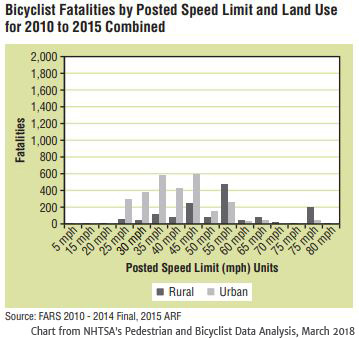
Before we talk about numbers, it’s important to know that there are differences between riding in urban and rural areas when talking about bicycle safety. Urban areas see 60%-71% of bicyclist fatalities across the nation and California is still in the top three states for cyclist fatalities. California’s ranking for cyclists fatalities might have something to do with having the largest population of any state and 87% of those nearly 40-million people living in urban areas (Stanford).
Then speed limit
where most bicycle fatalities occur in rural areas is 55 mph.
This speed is the zone with the second most bicyclist
fatalities overall; however, for urban riders, 55 mph is only the sixth-ranked
speed zone for fatalities. The approximately
29% of total rural cycling crashes with fatalities occurring in a 55 mph zone
is significant.
The speed limit where
most bicyclist fatalities occur in urban areas is 45 mph followed closely by 35
mph.
Because most bicyclist fatalities occur in urban areas, the
data gathered shows urban cyclist collision fatalities can occur in most speed
zones from 25 mph to 75 mph with the majority falling between 35 mph and 45
mph. Interestingly, the same speed zones
show the most urban pedestrian fatalities, too.
Speed Limits Are
Different Than Speeding
The information we just presented comes from speed limits, not speed travelled. Reports vary on the percentage of bicyclist fatalities resulting directly from speeding because being the leading cause is different than being one of several causes and can be difficult to separate. A 2010-2015 report found only 8.6% of bicyclist fatalities resulted directly from speeding (NHTSA, FARS, & ARF). But don’t think speeding isn’t a problem – in San Francisco, speeding is the leading cause of traffic collision deaths (SFPD 2010-2014) and is a leading contributor to traffic collision fatalities nationwide.
This report also found most fatalities for cyclists were
occurring in non-intersections. This
makes sense when the speed limit with the most fatalities for riders in urban
and rural locations combined is 45 mph followed by 55 mph; these speed zones
will have fewer intersections and crosswalks than zones with lower speeds.
Bicycle Safety Starts
With Awareness
Knowing what factors can lead to or increase the chances of a cyclist fatality can help riders and drivers be more aware of their surroundings. The bicycle accident attorneys at Rahman Law support Vision Zero for San Francisco and we look forward to the day when no cyclist or pedestrian will become a fatality statistic.
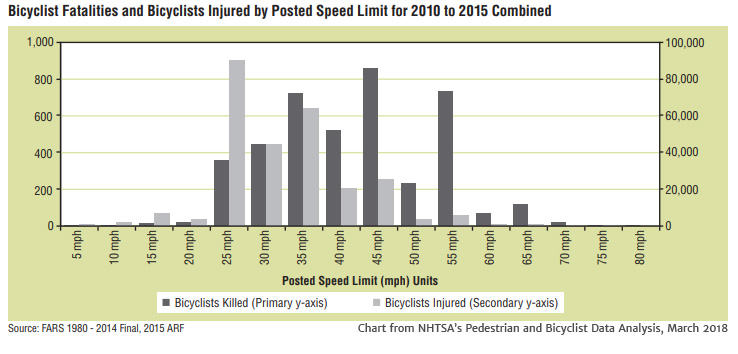
Most cyclist fatalities in urban and rural areas occur in 45
mph zones (link to other blog on fatalities); however, the likelihood of
sustaining a survivable injury as a pedestrian or cyclist in a 45 mph zone is
not the same.
What is the same is
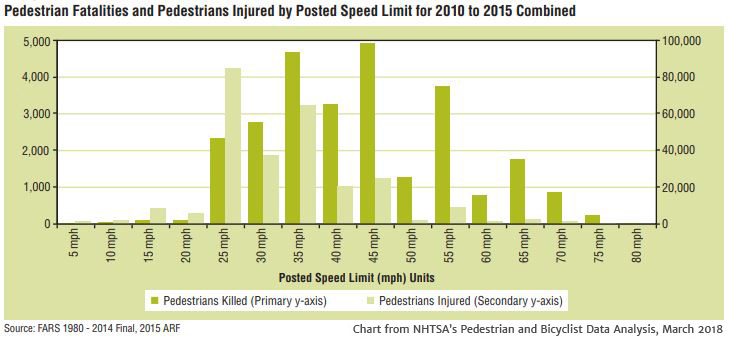
the speed limit where the most injuries occur: 25 mph.
Part of the reason most injuries occur for cyclists and
pedestrians in 25 mph zones is the survivability factor. The likelihood of sustaining a serious or
fatal injury in a collision with a vehicle as a pedestrian or cyclist goes up
dramatically from 18% at 20 mph to 77% at 40 mph (AAA Foundation). Another reason for more cyclist and
pedestrian injuries at lower speeds is the increased exposure as there are
likely going to be more pedestrians in a 25 mph zone than a 75 mph zone.
The speed limits where the most cyclist and pedestrian
injuries occur according to the NHTSA are 25 mph, 35 mph, and 30 mph (in that
order). This data is combined for urban
and rural areas. Keep in mind that the
data for injuries comes from serious injuries which are reported. There may be more injuries occurring than
what are reported and would likely be in lower speed zones because of the lack
for the need of medical care.
Speeding is Also
Responsible for Cyclist and Pedestrian Injuries
The information gathered by the NHTSA, NCSA, FARS, and ARF between 2010 and 2015 relied on speed limits to assume speed for much of their data. Speeding (going over the speed limit) factors into approximately 30% of all motor vehicle fatalities in the United States and is the leading cause of about 8% of pedestrian fatalities. The most common speed limit zone for pedestrian and cyclist fatalities to occur as a result of speeding is 35 mph. Specifics on the number of cyclist and pedestrian injuries that were a direct result of speeding was not published; however, 35 mph is the zone with the second-most injuries for both pedestrians and bicyclists, making it likely that there are a portion of injuries occurring as a direct result of speeding. The unfortunate reality is that speed kills.
Pedestrian Safety
The California Legislature enacted the Pedestrian Safety Act in 2000 which includes new requirements for driver education on pedestrian safety among other items. California Vehicle Code sections 21950-21954 provide legal measures for pedestrian safety and protection, including that drivers have a higher duty of care than pedestrians. And in San Francisco, pedestrian safety is going even further with Vision Zero to bring the number of pedestrian injuries and fatalities to zero. These measures are looking to increase pedestrian safety through more awareness and enforcement in California, including speed-related pedestrian safety issues.
As bicycle accident attorneys in San Francisco and Paso Robles, we talk to a lot of cyclists and we ride, too, so we know all too well that the short days of winter won’t stop you from riding. Many of us ride because we absolutely love it and don’t consider it a seasonal hobby. Others ride as a means to get to work and need to ride year-round. However, in the winter months there are some extra precautions cyclists need to take.
Let’s start with the basics; the five most common types of collisions between bicyclists and motor vehicles are:
A vehicle making a right turn across the cyclist’s lane of travel
A vehicle turning left at an intersection
Dooring
The failure of a motorist to stop at a red light or Stop sign
A vehicle or cyclist passing on the right
This bit of knowledge can help you be more aware in those environments and situations year-round. In the winter, people may be trying to get in and out of their vehicles faster due to cold weather and rain increasing the chances of a dooring. A cyclist is permitted to ride in the travel lane without going at the speed of traffic to avoid a hazard (CVC 21650; San Francisco Transportation Code Sec. 7.2.12). Signal and move over if you need to avoid a door that might open.
Here are Some Winter Riding Hazards and Our Winter Cycling Safety Tips:
Cycling When It’s Wet
California may not get a lot of rain, but it willeventually rain and that rain can flush debris into your bike lane including piles of slippery, wet leaves. Rain can also hide potholes underneath less conspicuous puddles.
Our winter cycling safety tip – Riding through a puddle is essentially riding into the unknown, so it is safer to avoid them.
Also, road surfaces can be the most dangerous just after the first rain in a while or after rain has just started because oil begins to surface. A rainbow-y sheen on a road can signal the dangers of an oil spot. These are most commonly found at intersections. Slick patches in the road can make it difficult to stop and/or turn.
Our winter cycling safety tip – Treat intersections with extra respect in the winter as they are already dangerous places for cyclists but the added element of oil can compound the problem. Treat patches with a rainbow sheen as a road hazard.
Remember what we said about avoiding doors – the same rules apply to any hazard in the bicycle lane and you may use the travel lane to avoid them. Remember to signal as the vehicle traffic may not expect you to come over if you see the hazard before they do.
Cycling In the Dark
We can’t say this enough: as riders it is important to be seen. The lights and reflectors required by California law are a great start, but more is better in this case. Fluorescent clothing can aid visibility during the day, but it’s lights and reflectors that make the biggest impact on your visibility at night.
Our winter cycling safety tip – Add reflective tape to your helmet, put lights in your wheel spokes, and/or wear a jacket with reflectors to boost your ability to be seen in the dark by others.
Some riders like to switch to yellow lenses in the winter to help them with glare. After you’ve outfitted yourself to be seen by others, make sure you can see them clearly, too.
Our winter cycling safety tip – If your usual riding glasses have a dark tint, explore other anti-glare options more appropriate for cloudy days; these might be clear, yellow, or even pink.
When riding at night in California, the following items are required:
Forward-Facing Bike Light: A white headlight is required. The light both makes you visible to others and illuminates your path. It needs to be visible from at least 300 feet forward. It may be attached to the bicycle or the rider. CVC 21201(d) & CVC 21201(e)
Rear-Facing Reflector or Light: A red reflector at the back is the minimum requirement, but a solid or flashing red bike light with a built-in reflector visible from 500 feet is also allowed. CVC 21201(d)
Side-Facing Reflectors: White or yellow reflectors are required to be visible on each side of the bicycle in three locations (forward, center, and rear), but there are multiple ways to meet this requirement. Side-facing central reflectors can be on the bicycle pedals, or on the shoes or ankles of the rider. There should be additional reflectors forward and rear of the central reflectors on each side of the bike like on the spokes, reflective tire sidewalls, or on the frame of the bicycle. CVC 21201(d)
Fixing ANY tire in the cold and wet is no fun. Add dark into that mix and, well… it gets complicated. Do yourself a favor and give your bike a winter checkup (even if you don’t ride a lot during the winter, seasonal checkups are a good rule of thumb for everyone). You’ll want to do everything you can to give yourself the ability to stop quickly when needed and avoid stopping for a fix in the rain.
Our winter cycling safety tip – Check your air, replace aged tubes, upgrade your chain lube or reapply it, and even fit your bike with a set of new brake pads before you go out into the winter weather.
The vision we share with many is that no pedestrian or bicyclist will be fatally injured by a vehicle in San Francisco – ever. The City of San Francisco is behind Vision Zero with a mandate to bring traffic deaths to zero by 2024. This year has been looking on track at reducing pedestrian fatalities, but we have reversed our progress for bicyclists and the San Francisco Bicycle Coalition has already said it is unacceptable. As bicycle accident attorneys, we agree. On Thursday, September 13th 2018, the fourth bicyclist this year was fatally injured by a vehicle in San Francisco.
To put this number into perspective, since 2009, the two times San Francisco has seen as many bicyclist fatalities were in years with over 30 total traffic fatalities: 2013 and 2015*. 2013 in particular was the year with the most overall traffic fatalities since 2010. It’s only September and we have already reached this unfortunate target. Based on traffic collision statistics, it is impossible to say that there won’t be another bicyclist fatality in San Francisco this year. Data is still being compiled for this year, but last year was a record breaking year with low numbers and this year had been low as well. Unfortunately, it is turning out to be unacceptably high for bicyclist accidents and fatalities, especially compared to the ratio of overall traffic fatalities for 2018:
Why Are Bicycle Accidents on The Rise in San Francisco?
The increase in injuries and fatalities is on the rise in the state by some data. It is harder to be certain when looking at data for 2018 as so much of it is still being aggregated. The Govenors Highway Safety Association (GHSA) which reviews road safety in all states found that in 2016 and 2017 pedestrians are now the largest proportion of traffic fatalities nationwide than they have been in 33 years. More people outside of cars are dying; it is on the rise as a nation and as a state. Year after year California fluctuates at the top of the nation for the state with the highest number of bicyclists and pedestrians killed each year in traffic collisions. Usually, we’re first in total number of deaths, but sometimes we’re second. This means what San Francisco is trying to do with Vison Zero goes against the majority of the nation, state, and metro-area statistics. It will take education, engineering, and enforcement, but as bicycle accident attorneys and advocates for safer streets for pedestrians and cyclists, we believe it is possible.
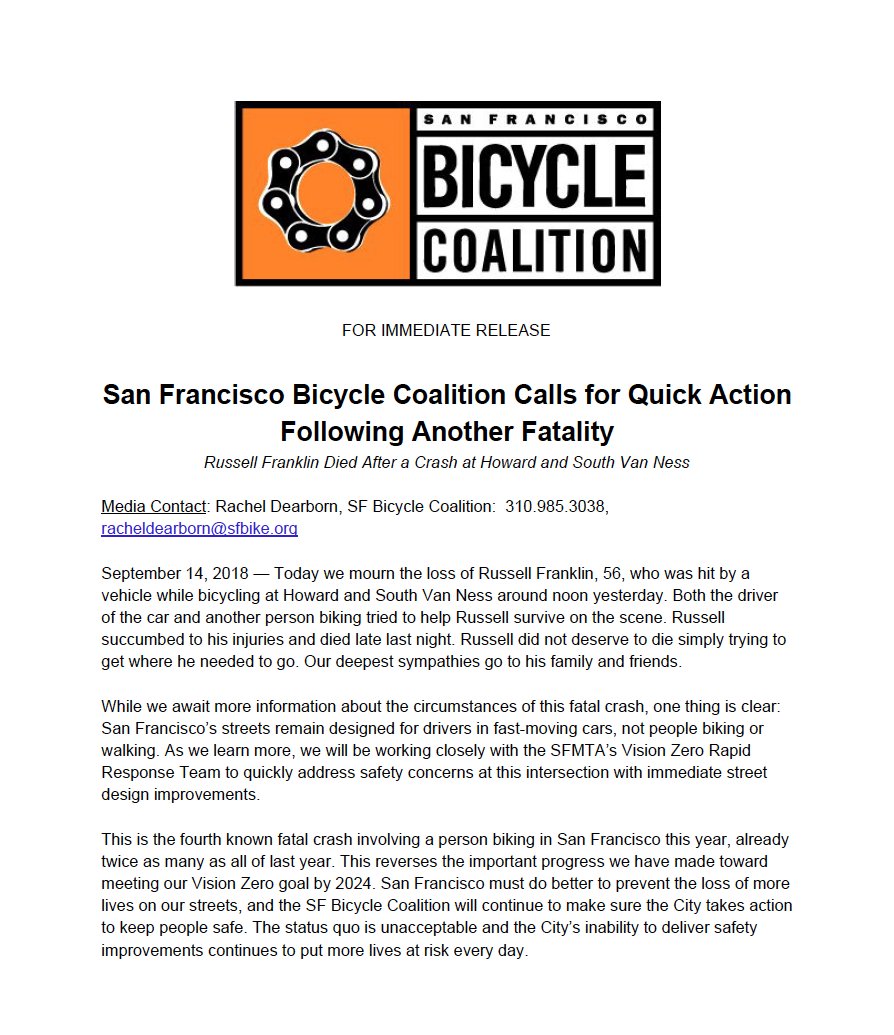
The most recent incident occurred outside of a Vision Zero high-injury corridor on the 1600 block on Howard Street near South Van Ness and 12th Streets (Hoodline). The cyclist was on his way to a bicycling rally to advocate for more protected bike lanes (SF Examiner). Studies have been showing bicyclists feel safer in these protected lanes and they are a part of Vision Zero. The San Francisco Bicycle Coalition is calling for quick action and asks that San Francisco do a better job to prevent more loss in their press release following this terrible tragedy.
What Can You Do To Prevent The Next Traffic Fatality?
Don’t touch your phone! Not for a call, text, or map. Never drive distracted. In 2015, 10% of traffic fatalities resulted from distracted driving (NHTSA). This is easy for you to avoid.
Never drive impaired by alcohol, drugs, or medications. Drivers who were impaired by drugs or alcohol in collisions resulting in a fatality has been dramatically increasing! In 2015 it was up to 42.6% (NHTSA). And the worst time for this is during the holidays… which is coming up.
Slow down. To put it simply: speed kills. Approximately 31% of traffic fatalities are a result of speeding as the main factor (NHTSA). And experts believe the increase in fatalities is due to more people speeding… Are you really in that big of a hurry?
Rahman Law PC is dedicated to making San Francisco’s streets safer for pedestrians and cyclists because we walk and ride these streets, too! As bicycle accident attorneys we regularly attend events and advocate for pedestrian and bicyclist rights. Four deaths in one year is a setback in the progress everyone has been working so hard for, but we will not give up. Even one death is one too many.
*Data from Vision Zero SF. Some data is still under investigation.
Receive new blogs via email:
[email-posts-subscribers namefield=”YES” desc=”Subscribe to receive our blogs in your inbox!”]
School is back in session and just like you, your child is a commuter. You may drive your child to school and give them a quick tuck-and-roll drop-off, or they may ride the bus, but some still pedal their way among the throngs of cars, pedestrians, and other cyclists. Or, you may have children who only cycle at home afterschool and on weekends. In either case, we wanted to share with you 5 rules every parent should know when letting their child ride their bike in San Francisco. Children under 14 accounted for 37% of all fatal bicycle accidents in 2015 and San Francisco is still in the top 13 cities in the entire United States for bicycle fatalities with motor vehicle collisions. It is important for parents to be vigilant.
1: Urban Cycling Ends at 6:00pm
The National Highway Traffic Safety Administration’s National Center for Statistics and Analysis looks hard at fatal bicycle accidents and tries to find patterns. One that they have found to be consistently true is the spike in bicycle accidents resulting in fatalities between 6:00pm and 9:00pm during any season. If your child has extracurricular activities keeping them out, make sure they are home with their bicycle before 6:00pm. If they have come home and gone out for a ride, the same rule applies.
2: Ride with Traffic
Ride in the same direction as traffic in the bike lane. Use the travel lane (the vehicle lane) when needed to avoid obstacles and always signal your actions with your hands to tell the drivers and other cyclists what you are doing. Children under the age of 13 may ride on the sidewalk in San Francisco (CVC 21560, San Francisco Transportation Code Sec. 7.2.12).
3: Always Wear an Approved Helmet
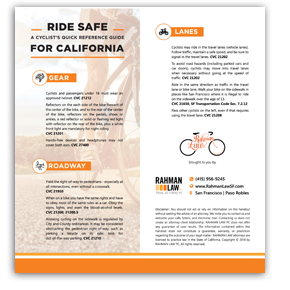
Cyclists and passengers under the age of 18 must wear an approved helmet. Parents – set a good example, be safe, and wear one, too! Also be sure the helmet is properly fitted. Many children will wear their helmet too far back away from the brow. In addition to a helmet, adding extra reflective gear is beneficial. Elastic straps that go around the ankles with hook-and-eye closures can catch headlights and give extra visibility.
4: No Surround Sound
Headphones may not be in/cover both ears (CVC 27400). Many children like to listen to music while commuting, but they may not have both ears covered while operating a bicycle. A hands-free device is permitted in one ear, but this may cause further distractions if a child tries to answer a phone call while navigating an urban area.
5: Obey the Lights and Signs
Children who have not yet learned to drive often don’t know to stop or yield in the right locations for signs and crosswalks which can potentially lead to bicycle accidents or collisions. When on a bike, operators must obey the same rules as a car, which means they must stop at a stop sign and wait their turn. If your child is commuting on their bicycle, consider riding their route with them a few times to help explain the lights and signs to them. DMV booklets contain road rules and can be picked up free of charge.
Talk to Your Child to Prevent a Bicycle Accident
These are 5 rules we think every parent should know before letting their child ride their bike in San Francisco. In California, the law regarding riding on the sidewalk varies from city to city, but the other rules are beneficial for adults who ride and parents with children who ride throughout California. As bicycle accident attorneys in San Francisco with a second office in Paso Robles, we talk to a lot of parents with concerns after an accident or a close-call who are looking for what they can do to prevent a bicycle accident. In the urban landscape of San Francisco, children need extra help learning about bicycle safety and constant reminders to ride safe. We hope these 5 rules will help you talk to your child about bicycle safety.
If you would like more information about the rules in California, you may download our Ride Safe Reference Guide here. It has these and other rules of the road for bicycle safety in California. And if you would like to talk to one of our bicycle accident attorneys in San Francisco or Paso Robles, contact us for a free consultation today!
It takes a long time for data to be compiled and released. In March of 2017, the National Highway Traffic Safety Administration’s National Center for Statistics and Analysis released their data from 2015 with comparisons going back to 2006. By gathering data over the years, the statistical team has sought to find patterns: is there a most fatal time of day for bicycle accidents with motor vehicles, or perhaps a demographic most likely to be in a fatal bicycle accident?
There is a difference between causality and correlation: a demographic might be found in a pattern but that in no way points to an immediate cause. Something we talk about frequently is the immediate blame placed on pedestrians, pedalcyclists, and motorcyclists when an accident occurs; we blame the victim. When a bicycle accident is fatal, the victim has lost their ability to speak which is one of many important reasons why they should not be immediately placed in the wrong. All avenues must be explored. So when a demographic is found to correlate to fatal bicycle accidents, we must explore that, too.
So, is your demographic most likely to be in a fatal bicycle accident?
Gender
Gender can rule out roughly half of the population. Men are more likely to be killed in a bicycle collision involving a motor vehicle than women and it’s a fairly significant difference (4.40% men v. 0.74% women). Men were also much more likely to be involved in a bicycle collision with a motor vehicle resulting in an injury without a fatality (229% men v. 54% women).
Age
Both men and women shared their top-tier category for the age with the highest number of fatal bicycle accidents (ages 55-59, 92m/16w) while men had their second-tier follow in age (50-54, 87), women were not as significant in difference for their second-tier apart from their third-tier (65-69, 13; 50-54, 12; 20-24, 12). Women also have the most reported bicycle accidents with injuries (not fatal) at 20-24 years of age. Men in their 50s and women in their early 20s or late 50s are all in the demographic that appears to be significant for bicycle accidents involving motor vehicles.
Region
As bicycle accident attorneys, we have offices in Paso Robles and San Francisco, California assisting with bicycle accident and personal injury cases. California was the first in the nation for pedestrian and bicycle fatalities for the longest time (as advocates to reduce those numbers, it felt like an eternity). Per the Traffic Safety Facts report, California is now second in the nation to Florida. It is a big win for our state as we have a larger population. In 2015, Florida had 150 pedalcyclist fatalities while California had 129. For other readers trying to determine if they are in an at-risk demographic, these are the only two states to have more than 100 fatalities in 2015. Texas is the third highest with 50 fatal bicycle accidents. Alaska, Idaho, Maine, Rhode Island, and Wyoming are the safest states for cyclists with none (and that is the list we really want California to be on!).
So why California, Florida, and Texas? The areas with the highest bicycle injury and fatality rates are the urban areas. The National Highway Traffic Safety Administration has compiled city data and the cities with the highest resident populations are most often the ones with the highest total bicycle fatalities. The total fatal traffic accidents of San Francisco including fatal bicycle accidents and fatal motor vehicle collisions with pedestrian made up over 10% of the entire country’s traffic fatalities for the year. Other urban regions with dense populations and high cyclist fatality rates here in California include Los Angeles, San Diego, and San Jose. Los Angeles, CA was the city with the most fatal bicycle accidents in 2015; New York, NY, was second.
Ride Safe
If you would like to read more about the demographics collected by the National Highway Traffic Safety Administration, you can download their Bicyclists and Other Cyclists Traffic Safety Facts report here. But knowing that your demographic is more or less likely to be in a fatal bicycle accident is not the end of safety precautions when riding. We want you to ride safe each and every time you go out there and that means proper gear, visibility, and knowing the rules of the road.
SAN FRANCISCO, California, July 17, 2018 – (Digital Journal) – Rahman Law PC announces their sponsorship of Bike East Bay’s Pedalfest 2018. Pedalfast is in its eighth year as is a free event to celebrate bikes and cycling with music, food, and art for the whole family to enjoy. Bringing in an estimated 25,000 attendees, the event is an opportunity for the bicycle accident attorneys at Rahman Law to support Bike East Bay’s mission to make bicycling “safe, fun, and accessible” through advocacy, education, and community engagement.
Principal and founder of Rahman Law, Shaana Rahman, is a member of Bike East Bay and has sponsored Pedalfest all eight years as a bicycle accident attorney and advocate for bicycle safety awareness inclusive of improvements to bikeways and streets, which is a shared vision of Bike East Bay. While much of Pedalfest revolves around the joy of bikes with amphibious races and a bicycle rodeo for children, there is still a commitment to “improving access to biking, walking and transit” while also “increasing the number of people who ride bicycles safely, confidently and knowledgeably” from Bike East Bay.
The team of bicycle accident attorneys at Rahman Law attend as many bicycling community events like Pedalfest in San Francisco each year as they can, to talk about bicycle safety, City advocacy measures, urban bicycle accident hazards, and answer common questions from cyclists.
“We want to get out there and talk to cyclists to help raise awareness on topics that could prevent catastrophic injuries,” said Ms. Rahman. “We support Vision Zero for San Francisco and a big part of that is education.”
Last year, a common safety topic the public asked the bicycle attorneys related to bicycle lighting. The team at Rahman Law is happy to talk to cyclists again this year and free consultations are available for those who cannot make it to the event at rahmanlawsf.com.
About Rahman Law PC
The personal injury lawyers at Rahman Law PC are powerful advocates for people who have been injured through no fault of their own. What makes Rahman Law PC different from other personal injury lawyers is they care about what happens to their clients; they aggressively advocate for their clients’ interests and have a personal relationship with each client, taking the time to listen and figure out solutions that make sense from a legal point of view but also from a human perspective. By providing the highest quality legal services to those who have been injured or have suffered wrongdoing at the hands of other individuals, corporations, or public entities, the personal injury lawyers and bicycle accident attorneys at Rahman Law PC have a proven track record of results and have successfully recovered millions of dollars for clients throughout California. Rahman Law PC offers clients attentive service backed with big firm experience, making them ready to take on any opponent. To learn more about the personal injury lawyers at Rahman Law PC, visit http://www.rahmanlawsf.com or call (415) 956-9245 in San Francisco, (805) 619-3108 in Paso Robles, California.
When someone talks about holiday traffic and safety in California, they often focus on “the” holidays in November and December, but for bicyclists and pedestrians, the summer holidays like The 4th of July and Labor Day can be quite hazardous, possibly more so than the holidays at the end of the year because there is more cycling and walking to do in the summer when it’s so beautiful outside! We want to share three important things you should look out for this summer we’ve learned as bicycle accident attorneys working in San Francisco and Paso Robles where the summer is a great time to get outside and ride.
One: Summer Tourists Don’t Expect You
We do a lot as bicycle accident attorneys to advocate in San Francisco and San Luis Obispo County for safer conditions for cyclists. Some areas are beginning to have better lane markings and even separated bike lanes, which is great! But despite better conditions where available, at any time a tourist is unfamiliar with the road in a new place and doesn’t know to expect a bike lane or a bicyclist. They don’t know the road they are on is a local favorite for riding. They also may not have their eyes fully on the road as they look for their next turn, or at the beautiful scenery. Summer is here and so are the tourists. As a bicyclist or pedestrian, we must all be paying attention to the traffic around us at all times (and remember – we are all pedestrians at some point during our day!).
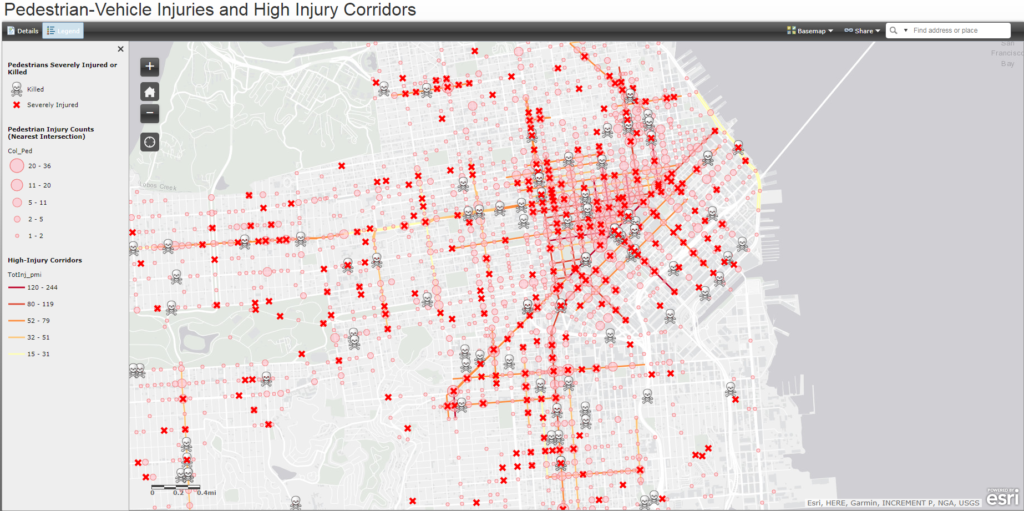
How much should we be paying attention? Not just to one car here are there, but to all of them! The San Francisco Travel Association said 25.5 million people visited San Francisco City in 2017. Not all tourists come with a car or rent one, but many do. And if you live or have been to San Francisco, you know there are many narrow and one-way streets to pay attention to. The 13% of roads in San Francisco where 75% of collisions with pedestrians are occurring are located in areas where tourists want to be (see the map and click on it to see the live version) bringing up concerns for pedestrians and bicyclists now that summer is here and has brought with it an influx of heavy tourism. This is not to say that tourism is bad – tourism is a good thing for local economies. But as bicycle accident attorneys we know first-hand the hazards cyclists face.
Two: Summer DUIs are Rising
A lot of bicycle accidents are caused by vehicle drivers who are under the influence. In California, DUIs are rising. Drivers in collisions resulting in a fatality who were impaired by drugs or alcohol rose from 26.2% to 42.6% between 2005 and 2015 (National Highway Traffic Safety Administration). In San Luis Obispo, bicycle collisions have been decreasing (down 11% from 2015 to 2016), but DUIs have been increasing and in August of 2017, a cyclist was killed in a hit-and-run collision. The alleged driver was 17-years-old and intoxicated. California State as a whole appears to have seen a decrease in annual DUIs, depending on which report you read; however, holiday DUIs always show a spike which is why we want to remind pedestrians and cyclists to be careful during the summer and especially during the holidays. The 4th of July holiday is the deadliest holiday due to collisions with the most fatalities over any other time period during the year (National Highway Traffic Safety Administration). As the Thanksgiving holiday has the most traffic, alcohol and drugs have to be questioned with the 4th of July. DUI-related collisions can happen at any time, but statistically are more likely to be fatal starting after 8:00pm, peaking between midnight and 3:00am (National Highway Traffic Safety Administration). Remember to add extra lights to your bicycle if you plan to ride at night to give yourself as much visibility as possible. While tourists can possibly be driving under the influence of alcohol or drugs as they’ve been out partying, the locals can be to blame on this one, too. This is why we suggest keeping the phone number of a good bicycle accident attorney in your phone (hey – like us!), just in case something happens and you are unsure of what to do next.
Three: New Drivers and Teens on Summer Break
If you are the parent of a new driver, you may have heard of the “100 Deadliest Days,” but if you’re a cyclist or pedestrian and haven’t heard this term, you need to know about this. The 100 deadliest days for teen drivers fall between Memorial Day and Labor Day as these are the days when the most fatalities involving collisions and teen drivers occur. In 2016, there were about 10 people killed per day by a teen driver in this window, which was a 14% increase from 2015 (AAA Foundation for Traffic Safety). Of these 100 days, there are 10 considered the most deadly (9 falling between May and August) and are believed to be so dangerous due to teenage drinking. With or without substance abuse, new drivers are out in full force during the summer. The risk for them is highest at night (considered after 9:00pm by AAA) and/or if they are speeding. If you have a new driver, be sure to talk to them about the added risks of substance abuse, speeding, and reduced visibility. If you are a cyclist or pedestrian, be extra alert during these summer months.
Need a Bicycle Accident Attorney?
We want you to be safe and have fun this summer, but if things don’t go as planned and you think you might need a bicycle accident attorney in San Francisco or Paso Robles/San Luis Obispo, give us a call! We are happy to provide you with a free consultation. We also have two helpful free downloads you might want to save now for future use to keep in your phone, glovebox, or bike-bag:
THE PROPERTY DAMAGE DEMAND TOOLKIT: How to get the Insurance Company to Pay you for your Damaged Bike After a Crash
The information you obtain at this site is not, nor is it intended to be, legal advice. You should consult an attorney for advice regarding your individual situation. RAHMAN LAW PC is unable to identify which statute of limitation will apply without a thorough review of your potential case. Therefore, the information contained on this website does not constitute legal advice. Statutes of limitation change as new laws are passed. You should consult with a lawyer immediately to fully evaluate your case.
You should not act or rely on information in this website without seeking the advice of an attorney. We invite you to contact us and welcome your calls, letters and electronic mail. Contacting us does not create an attorney-client relationship. Please do not send any confidential information to us until such time as an attorney-client relationship has been established.
RAHMAN LAW PC does not offer any guarantee of case results. Past success in litigation does not guarantee success in any new or future lawsuit. The information contained within this website does not constitute a guarantee, warranty or prediction regarding the outcome of your legal matter.
To the extent the State Bar rules require us to designate a principal office and/or single attorney responsible for this site, RAHMAN LAW PC designates Shaana Rahman as being the attorney responsible for the site. Ms. Rahman can be reached at 177 Post Street, Suite 750, San Francisco, California 94108, 415.956.9245.
By sending an email through this website (rahmanlawsf.com), you are providing us with your email address and permission to contact you via email. You may unsubscribe to our email communications at any time using the link provided in the email communication.








 As
As 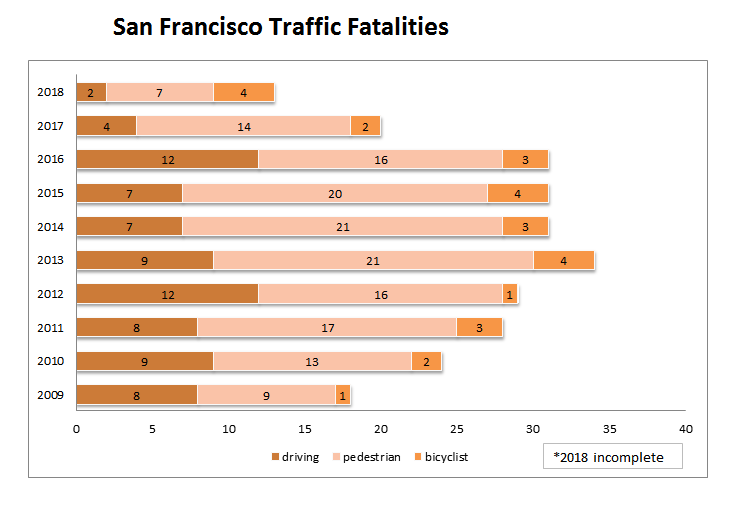
 School is back in session and just like you, your child is a commuter. You may drive your child to school and give them a quick tuck-and-roll drop-off, or they may ride the bus, but some still pedal their way among the throngs of cars, pedestrians, and other cyclists. Or, you may have children who only cycle at home afterschool and on weekends. In either case, we wanted to share with you 5 rules every parent should know when letting their child ride their bike in San Francisco. Children under 14 accounted for 37% of all fatal bicycle accidents in 2015 and San Francisco is still in the top 13 cities in the entire United States for bicycle fatalities with motor vehicle collisions. It is important for parents to be vigilant.
 It takes a long time for data to be compiled and released. In March of 2017, the National Highway Traffic Safety Administration’s National Center for Statistics and Analysis released their data from 2015 with comparisons going back to 2006. By gathering data over the years, the statistical team has sought to find patterns: is there a most fatal time of day for bicycle accidents with motor vehicles, or perhaps a demographic most likely to be in a fatal bicycle accident?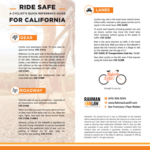


 Download the free guide here: